Philadelphia International Airport (IATA: PHL, ICAO: KPHL, FAA LID: PHL) is the primary international airport serving Philadelphia, Pennsylvania, United States. It served 30.1 million passengers annually in 2025, making it the busiest airport in Pennsylvania and the 21st-busiest airport in the United States. The airport is located 7 miles (11 km) from Center City Philadelphia and has 22 airlines that offer nearly 500 daily departures to more than 130 destinations worldwide.
The airport is the fifth-largest hub for American Airlines and serves as American Airlines' primary hub in the Northeastern United States and its primary European and transatlantic gateway. The airport is also a regional cargo hub for UPS Airlines and a focus city for Frontier Airlines. The airport has service to cities in the United States, Canada, Mexico, the Caribbean, Europe, and the Middle East. As of 2019, the airport offers flights to 140 destinations, 102 of which are domestic and 38 of which international.
Much of the airport property is in the city of Philadelphia. Terminal A, the international terminal, and the western and southern ends of the airfield are in Tinicum Township, Delaware County. PHL covers 2,302 acres (932 ha) and has four runways.
Philadelphia International Airport is an important component of the economies of the Philadelphia metropolitan area, and Pennsylvania. The Commonwealth's Aviation Bureau reported in its Pennsylvania Air Service Monitor that the total economic impact made by the state's airports in 2004 was $22 billion. In 2017, the airport commissioned a new economic impact report, which found that it accounted for $15.4 billion in economic activity, $5.4 billion in total earnings, and over 96,000 direct and indirect jobs. In October 2022, the airport gained a direct connection to a Colonial Pipeline fuel supply.
== History ==
=== 20th century ===
Starting in 1925, the Pennsylvania National Guard used the present airport site (known as Hog Island) as a training airfield. The site was dedicated as the "Philadelphia Municipal Airport" by Charles Lindbergh in 1927, but it had no proper terminal building until 1940; airlines used Camden Central Airport in nearby Pennsauken Township, New Jersey. Once Philadelphia's terminal was completed (on the east side of the field) American, Eastern, TWA, and United moved their operations here.
In 1947 and 1950, the airport had runways 4, 9, 12 and 17, all 5,400 feet (1,600 m) or less. In 1956 runway 9 was 7,284 feet (2,220 m); in 1959 it was 9,499 feet (2,895 m) and runway 12 was closed. Not much changed until the early 1970s, when runway 4 was closed and 9R opened with 10,500 feet (3,200 m).
On June 20, 1940, the airport's weather station became the official point for Philadelphia weather observations and records by the National Weather Service.
During World War II the United States Army Air Forces used the airport as a First Air Force training airfield.
Beginning in 1940, Rising Sun School of Aeronautics of Coatesville performed primary flight training at the airport under contract to the Air Corps. After the Pearl Harbor Attack, the I Fighter Command Philadelphia Fighter Wing provided air defense of the Philadelphia metropolitan area from the airport. Throughout the war, various fighter and bomber groups were organized and trained at Philadelphia airport and assigned to the Philadelphia Fighter Wing before being sent to advanced training airfields or being deployed overseas. Known units assigned were the 33d, 58th, 355th and 358th Fighter Groups.
In June 1943, I Fighter Command transferred jurisdiction of the airport to the Air Technical Service Command (ATSC). ATSC established a sub-depot of the Middletown Air Depot at the airport. The 855th Army Air Forces Specialized Depot unit repaired and overhauled aircraft and returned them to active service, and the Army Air Forces Training Command established the Philco Training School on January 1, 1943, which trained personnel in radio repair and operations.
In 1945, the Air Force reduced its use of the airport and it was returned to civil control that September.
Philadelphia Municipal became Philadelphia International Airport in 1945, when American Overseas Airlines began direct flights to Europe. A new terminal opened in December 1953; the oldest parts of the present terminal complex (B and C) were built in the late 1950s.
As of April 1957, the airport was providing 30 weekday departures on Eastern, 24 on TWA, 24 on United, 18 on American, 16 on National, 14 on Capital, six on Allegheny, and three on Delta. To Europe, five Pan Am DC-6Bs a week via Idlewild and Boston and two TWA 749As a week via Idlewild; one TWA flight continued to Ceylon. Eastern and National had nonstops to Miami, but the TWA 1049G to LAX that started in 1956 was the only nonstop beyond Chicago. The first scheduled jets were TWA 707s in the summer of 1959.
Terminal B/C modernization was completed in 1970, Terminal D opened in 1973 and Terminal E in 1977; the $300 million expansion was designed by Arnold Thompson Associates, Inc. and Vincent G. Kling & Associates.
In the 1980s, the airport hosted several hubs. The Airline Deregulation Act of 1978 allowed regional carrier Altair Airlines to create a small hub at PHL using Fokker F-28s. Altair began in 1967 with flights to cities such as Rochester, New York, Hartford, Connecticut and to Florida until it ceased operations in November 1982. In the mid-1980s Eastern Air Lines opened a hub in Concourse C. The airline declined in the late 1980s and sold aircraft and gate leases to Chicago-based Midway Airlines. Midway operated its Philadelphia hub until it ceased operation in 1991. During the 1980s US Airways (then called USAir) built a hub at PHL.
US Airways became the dominant carrier at the airport in the 1980s and 1990s and shifted most of its hub operations from Pittsburgh to Philadelphia in 2003. As of 2013, the airport was US Airways' largest international hub and its second-largest hub overall behind Charlotte. PHL became an American Airlines hub after it completed its merger with US Airways in 2015 and remains one of the airline's biggest hubs, offering an average of 420 departing flights per day to over 100 destinations. In recent years, American has opted to continue expanding at PHL while downsizing its hub at JFK in New York due to greater slot availability, lower operation costs in Philadelphia, and its greater network of connecting flights.
In July 1999, the Pennsylvania Department of Transportation (PennDOT) and several U.S. federal government agencies selected a route for the connecting ramps from Interstate 95 to the Terminal A-West complex, then under development; the agency tried to avoid the John Heinz National Wildlife Refuge at Tinicum. K/B Fund II, the owner of the International Plaza complex, formerly the Scott Paper headquarters Scott Plaza, objected to the proposed routing, saying it would interfere with International Plaza development. It entered a filing in the U.S. Court of Appeals for the Third Circuit to challenge the proposed routing.
=== 21st century ===
In 2000, the airport attempted to acquire the complex for $90 million but Tinicum Township commissioners stopped the deal from going forward, citing concerns of a loss of tax revenue for the township and the Interboro School District, which serves Tinicum and noise pollution concerns.
In 2002 construction on the controversial new entrance ramps went forward. The new ramps eliminated the traffic signal and stop intersections previously encountered by northbound I-95 motorists who had to use Route 291 to the airport. The project consisted of six new bridges, more than 4,300 linear feet of retaining walls, and 7.7 lane miles of new pavement. The project also included new highway lighting, overhead sign structures, landscaping and the paving of Bartram Avenue. Also under the project, PennDOT resurfaced I-95 between Route 420 and Island Avenue and built a truck enforcement and park-and-ride facility. In 2003 Terminal A-West opened, with a 1,500-space parking garage. Construction of the terminal was funded by airport revenue bonds sold by the Philadelphia Authority for Industrial Development.
By 2005 two studies dealt with expanding runway capacity at PHL: the Runway 17–35 Extension Project EIS and the PHL Capacity Enhancement Program EIS. Completed in May 2009, the Runway 17-35 Extension Project extended runway 17–35 to a length of 6,500 ft (2,000 m), extending it at both ends and incorporating the proper runway safety areas. Other changes made with the Runway 17–35 Extension Project included additional taxiways and aprons, relocation of perimeter service roads, and modifications to nearby public roads.
The status of Philadelphia as an international gateway and major hub for American Airlines and the growth of Southwest Airlines and other low-cost carriers have increased passenger traffic to record levels in the mid-2000s; in 2004 28,507,420 passengers flew through Philadelphia, up 15.5% over 2003. In 2005, 31,502,855 passengers flew through PHL, marking a 10% increase since 2004. In 2006, 31,768,272 passengers travelled through PHL, a 0.9% increase. US Airways commenced a nonstop flight to Tel Aviv in July 2009. It operated an Airbus A330 on the route.
In 2011, a nearly 85,000-square-foot mural was completed along the sides of the airport parking garages that face I-95. The design includes images taken from photographs of Philadelphians dancing by local photographer JJ Tiziou. More than 800 people painted the mural over four months.
On November 14, 2019, after a five-year project, extended Runway 27L was dedicated and opened for operations. The runway was extended 1,500 feet to 12,000 feet with several new taxiways to accommodate the newest fleet of large aircraft that are popular on many long-haul flights. Runway 9R/27L, at 12,000 feet is the longest civil runway in all of Pennsylvania.
In 2023, the airport began a $15 million multi-year project to renovate and expand the airport's restroom facilities, funded by a FAA Airport Terminal Program grant included in the federal Infrastructure Investment and Jobs Act that was signed into law by President Joe Biden. The project will construct two new restrooms, five lactation suites, four service animal relief areas, 49 gender neutral restrooms, three adult assisted care restrooms, and upgrade 30 existing restrooms to be compliant with the Americans with Disabilities Act. In 2024, the airport received $20.4 million in federal funds allocated from the Infrastructure Investment and Jobs Act to perform HVAC and electrical system repairs at several terminals, baggage claims and ticket areas, and pedestrian bridges.
== Facilities ==
=== Terminals ===
Philadelphia International Airport has six terminals with a total of 126 gates. Non pre-cleared international arrivals are processed in Terminal A. American operates Admirals Clubs in Terminal A, the B/C connector and Terminal F. Terminal A also contains a British Airways Galleries Lounge as well as a American Express Centurion Lounge. Terminal D contains a United Club as well as a Delta Sky Club. A USO lounge is located in Terminal E.
=== Terminal A ===
Terminal A is divided into two sections, east and west. Terminal A West has 13 gates, while Terminal A East has 11 gates. The 800,000 sqft Terminal A West has a modern and innovative design, made by Kohn Pedersen Fox, Pierce Goodwin Alexander & Linville and Kelly/Maiello. Opened in 2003 as the new international terminal, it is now home to American (domestic and international), British Airways, and Discover Airlines. Terminal A-West's check-in lobby is located on the first floor, and it has over 60 counters. The ceiling of the check-in lobby extends to the second floor. Terminal A-West offers a variety of international dining options. Passenger Transfer Vehicles (PTVs), also known as Mobile Lounges or "Plane Mates" remain in use to support inte
المصدر: ويكيبيديا — النص وفق رخصة CC BY-SA. راجع الموقع الرسمي للمعلم للمواعيد والأسعار الحالية.
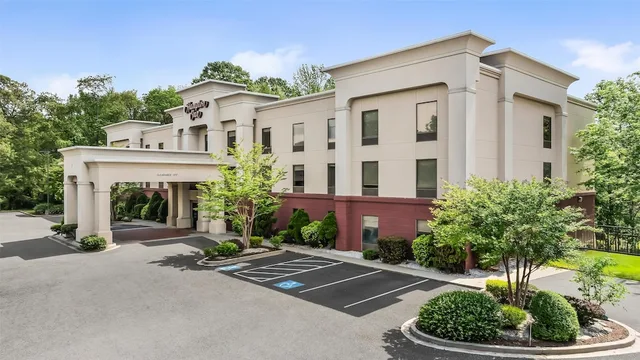
 فنادق قريبة من مطار فيلادلفيا الدولي (PHL)