Munich Airport (German: Flughafen München “Franz Josef Strauß“; IATA: MUC, ICAO: EDDM) is an international airport serving Munich and the surrounding region of Upper Bavaria and Lower Bavaria. Located 28.5 km (17.7 mi) northeast of Munich near the town of Freising, it is named after former Bavarian minister-president Franz Josef Strauss. According to the German Aeronautical Information Publication, the airport's official English name is Muenchen Airport.
The airport is the second-busiest in Germany after Frankfurt Airport and the eleventh-busiest in Europe, handling 41.6 million passengers in 2024. It ranked as the 39th-busiest airport worldwide that year.
Munich Airport is a hub for Lufthansa. It has two passenger terminals, two runways, and extensive cargo and maintenance facilities capable of handling wide-body aircraft such as the Airbus A380.
== History ==
=== Foundation ===
Munich Airport was named after Franz Josef Strauss, Minister-President of Bavaria from 1978 until 1988, who had supported the project and promoted Bavaria as an aviation hub. Strauss, a private pilot, also served as the first chairman of the Airbus supervisory board.
The airport opened on 17 May 1992. Munich-Riem Airport, the city's previous airport, closed on 16 May 1992, and the IATA airport code MUC and the ICAO airport code EDDM were reassigned from Munich-Riem Airport to the new Munich Airport.
=== Operations ===
Passenger traffic more than doubled between 1995 and 2006, from under 15 million to over 30 million annually, despite the impact of the September 11 attacks.
To accommodate growth, Terminal 2 opened in June 2003 as a dedicated facility for Lufthansa and its Star Alliance partners. In 2015, more than 40 million passengers passed through Munich Airport for the first time. In 2018 the airport recorded 46.2 million passengers and 413,000 aircraft movements, serving 266 destinations.
In 2015 Condor announced a new long-haul base at Munich, followed later that year by Transavia opening a base with four aircraft; Transavia closed the operation in 2017. In 2016 Eurowings established a base with routes operated by Air Berlin under a wet-lease agreement. In 2021, Lufthansa announced it would take over most of Eurowings’ Munich services.
=== Corporate identity ===
In November 2013 the airport introduced a new corporate design. The stylized "M" remained but adopted a different typeface and a colored dash, with animated versions installed at prominent locations such as the Terminal 2 satellite.
== Terminals and facilities ==
Munich Airport covers 1,575 hectares (3,892 acres) of land. Most facilities are located in the central area between the two parallel runways. The western zone contains cargo and maintenance facilities, administrative buildings, parking areas, and the Visitors’ Centre. Moving east are the west apron, Terminal 1, the Munich Airport Center (MAC), Terminal 2, and the east apron. The airport has two passenger terminals, each designed to handle tens of millions of passengers annually.
=== Terminal 1 ===
Terminal 1 is the older of the two passenger terminals and began operation when the airport opened on 17 May 1992. It is subdivided into five modules (A–E). Modules A–D provide facilities for both departures and arrivals, while module E handles arrivals only, making each module a largely self-contained unit. Modules A and D are used for flights within the Schengen Area, while modules B and C handle non-Schengen destinations. A separate facility, Hall F, is located near Terminal 2 and serves flights requiring additional security measures, such as those to Israel. Some check-in counters for Terminal 1 flights are also located in the central area Z (German: Zentralbereich), which houses much of the terminal’s shopping, dining, and the airport’s suburban railway station.
The terminal’s pier is 1,081-metre (3,547-foot) long and has 21 jet bridges, including one gate equipped with three jet bridges for the Airbus A380, used by Emirates. There are also around 60 apron stands, some with specially designed bridges that allow boarding via bus transfer.
Terminal 1 today mainly accommodates airlines that are not members or partners of the Star Alliance. Major users include American Airlines, Cathay Pacific, Condor, Delta Air Lines, easyJet, Eurowings, Emirates, Etihad Airways, Qatar Airways, and TUI fly Deutschland.
=== Terminal 2 ===
Terminal 2 opened on 29 June 2003 with an initial capacity of about 25 million passengers per year. In January 2009 an additional transfer level was introduced in response to new European Union security requirements, allowing separation of passenger flows.
The terminal is primarily used by Lufthansa and its Star Alliance partners. Luxair also operates from the building.
Terminal 2 is arranged around a central plaza rather than modules, as in Terminal 1. It has two main departure levels: Level 4 (G) for Schengen flights and Level 5 (H) for non-Schengen flights, plus bus gates on Level 3. The main pier is about 980 m (3,220 ft) long and includes 24 jet bridges, with more than 70 aircraft stands on the east apron. Additional west apron stands are sometimes used, with passengers transferred by bus. The terminal is equipped to handle large aircraft such as the Airbus A380, particularly after the opening of the Terminal 2 Satellite building.
The facility is operated by Terminal-2-Betriebsgesellschaft (Terminal 2 Operating Company), a joint venture between Flughafen München GmbH (60%) and Lufthansa (40%), making it the first German terminal co-operated by an airline.
==== Terminal 2 Satellite ====
Terminal 2 was projected to reach full capacity of about 27.5 million passengers per year by 2013. Plans for an expansion were developed in cooperation with Lufthansa and its Star Alliance partners. The satellite design allowed for additional capacity while retaining shared facilities such as check-in and baggage claim in Terminal 2 to simplify transfers within the Lufthansa and Star Alliance network. Preparations for the project began soon after Terminal 2 opened in 2003.
The €650 million project was funded 60% by Munich Airport and 40% by Lufthansa. Construction was approved in 2010 and began in 2012. The building was completed in late 2015, followed by trial operations in January 2016. It was inaugurated on 22 April 2016 and opened for passengers on 26 April 2016.
The satellite building is 609 m long and has 125,000 m² of floor space. It provides 52 additional gates and 27 aircraft stands, 11 of which can accommodate wide-body aircraft including the Airbus A380. Facilities are divided by function: Level K for Schengen flights, Level L for non-Schengen, and a J area for apron bus boarding. The terminal includes 44 passport control stations, 24 security lanes for transfer passengers, five Lufthansa lounges, and additional restaurants and shops. As an airside-only facility, all check-in, baggage claim and public arrivals functions remain in Terminal 2. A fully automated underground people mover system by Bombardier Transportation connects Terminal 2 and the satellite. The terminal handled its one millionth passenger in July 2016, less than three months after opening.
Plans for further expansion include extending the satellite building into a T-shaped layout and a possible third terminal to the east. In March 2026 Lufthansa and Flughafen München GmbH announced satellite building will be expanded with a pier connecting at a right angle to the east. The expansion is scheduled to open in 2035 and will increase the terminal's annual capacity by up to 10 million passengers.
=== Munich Airport Center ===
The Munich Airport Center (MAC) is a shopping, business and recreation complex that links the terminals. The older Central Area (Zentralbereich), originally built as part of Terminal 1, contains a shopping mall and the Munich S-Bahn station. The newer MAC Forum, completed with Terminal 2, is a covered outdoor area with a large transparent roof.
Adjacent to the forum is the airport hotel, operated by Hilton Hotels & Resorts, designed by architect Helmut Jahn with landscape architecture by PWP Landscape Architecture. It opened in 1994.
The MAC also houses a supermarket that is permitted to trade daily from 05:30 until midnight, including Sundays, as an exemption to Bavarian retail hour restrictions (Ladenschlussgesetz).
=== Runways ===
The airport has two parallel concrete runways, 08R/26L and 08L/26R, each 4,000 m (13,000 ft) long and 60 m (200 ft) wide, as well as one helipad.
Plans for a third runway have been proposed but remain subject to political and legal debate.
=== Parking areas ===
Munich Airport provides five parking garages and six underground car parks with a total capacity of around 30,000 spaces, of which about 16,500 are covered. The largest facility, garage P20 at Terminal 2, opened in 2003 with 6,400 spaces on eleven levels (four underground) and was the largest in Germany until surpassed by the car park at Allianz Arena in 2005.
A parking guidance system directs drivers to available spaces. Additional premium options are offered, including valet parking, hotel-and-parking packages, oversized spaces, and secure parking areas. Short-term spaces are available east of the central area, with 30 minutes of free parking, and seasonal discounted rates are provided in the P8 garage.
=== Observation facilities ===
Munich Airport operates a Visitors Park that includes a viewing hill overlooking the western apron and Terminal 1, together with a restaurant, gift shop and playground. Three historic aircraft are displayed in the park: a Lockheed Super Constellation, a Douglas DC-3 and a Junkers Ju 52. The site is served by Munich Airport Besucherpark station.
A second viewing facility is located on the roof of Terminal 2. This free observation deck features a wide glassed balcony with seating areas, offering views of the eastern apron and the Terminal 2 Satellite building. The terrace is accessible from the public (landside) area of the terminal.
== Airlines and destinations ==
=== Passenger ===
The following airlines offer regular scheduled and charter flights at Munich Airport:
== Statistics ==
=== Annual traffic ===
Source: Munich Airport
=== Busiest routes ===
All figures below are for 2020, reflecting the impact of the COVID-19 pandemic.
== Facilities ==
Munich Airport hosts several aviation-related operations. Lufthansa maintains a Flight Operations Center for crews based at Munich Airport, and its subsidiary Lufthansa CityLine moved its administration offices from Cologne to the airport in 2014. Lufthansa Technik operates a maintenance facility able to service wide-body aircraft, including the Boeing 747.
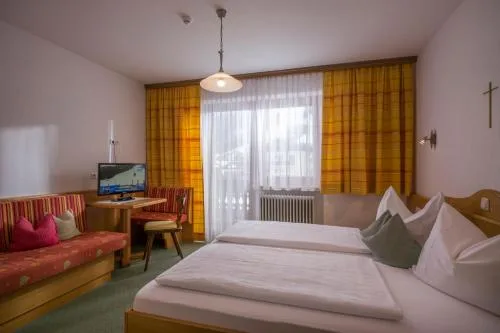
Two hotels are located on the airport grounds. The Hilton Munich Airport, originally opened as the Kempinski Hotel Airport Munich and rebranded on 31 December 2014, is situated near Terminal 2, while a Novotel serves the long-term parking area. Additional accommodation is available in nearby communities.
In 2010 Audi opened a training facility at the airport for its dealers, with designated apron areas used for driving instruction.
The German airline DBA, originally Deutsche BA, previously maintained its head office at the airport and in nearby Hallbergmoos.
The helicopter operations division of the Bavarian State Police (Hubschrauberstaffel Bayern) is based at the airport.
== Environment ==
Since November 2005, Munich Airport has held a certified environmental management system under ISO 14001 and the Eco-Management and Audit Scheme (EMAS). The airport also participated in the Air Transport Initiative for Germany alongside Fraport, Deutsche Flugsicherung and Lufthansa. Within this framework it developed a "four-pillar strategy" aimed at reducing emissions, improving infrastructure efficiency, optimizing operations and creating economic incentives.
=== Landscape ===
Environmental and nature-conservation aspect
Source: Wikipedia — text available under CC BY-SA. Check the place’s official website for current hours and ticket prices.
 Hotels near Munich Airport (MUC)